When Jesus met a Samaritan woman at a well, she challenged him concerning which inherited tradition and place of worship was correct:
The woman said to him, “Sir, I perceive that you are a prophet. Our fathers worshiped on this mountain, but you say that in Jerusalem is the place where people ought to worship.” Jesus said to her, “Woman, believe me, the hour is coming when neither on this mountain nor in Jerusalem will you worship the Father. You worship what you do not know; we worship what we know, for salvation is from the Jews. But the hour is coming, and is now here, when the true worshipers will worship the Father in spirit and truth, for the Father is seeking such people to worship him. God is spirit, and those who worship him must worship in spirit and truth.” (John 4:19-24)
Jesus pointed the woman to God’s Word. To worship the Father in Spirit and in truth means to worship God as he commands, believing in his promises, because we are sanctified in the truth, and God’s Word is truth.
When Apollos, a man trained in Scripture and keen to tell people about Christ, came to Ephesus, he spoke zealously, but his understanding remained incomplete:
Now a Jew named Apollos, a native of Alexandria, came to Ephesus. He was an eloquent man, competent in the Scriptures. He had been instructed in the way of the Lord. And being fervent in spirit, he spoke and taught accurately the things concerning Jesus, though he knew only the baptism of John. He began to speak boldly in the synagogue, but when Priscilla and Aquila heard him, they took him aside and explained to him the way of God more accurately. (Acts 18:24-26)
Priscilla and Aquila did not dismiss Apollos, but met with him privately and explained the way of God to him more accurately. Apollos received fuller instruction and continued preaching the Gospel of Christ boldly.
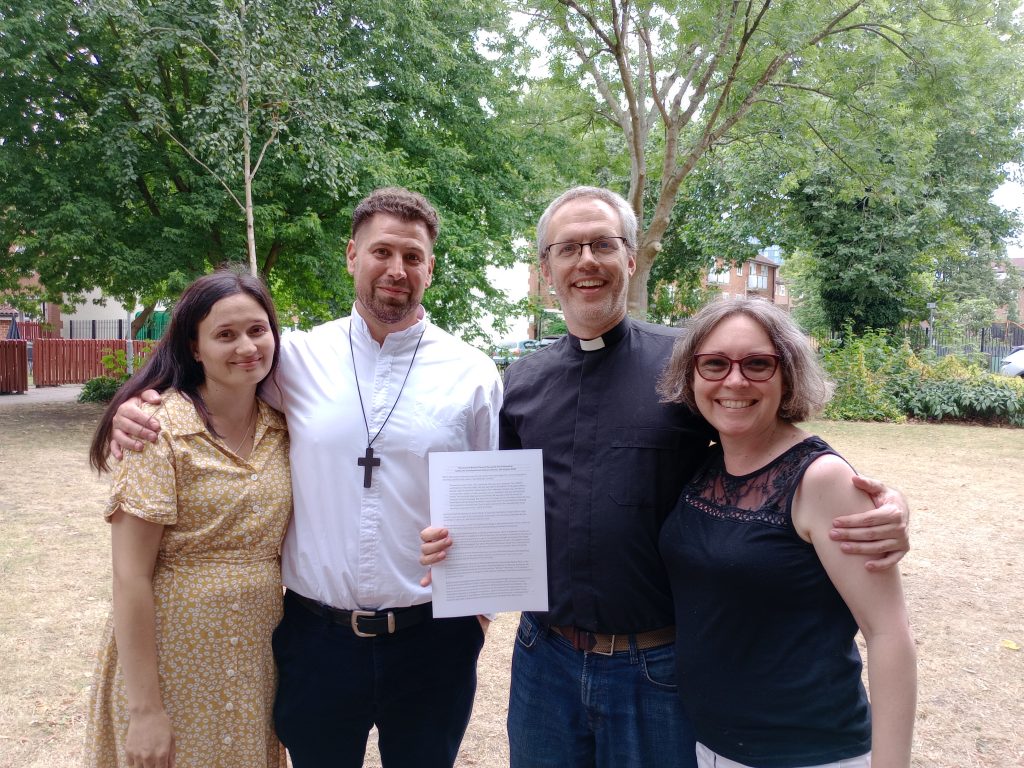
In recent weeks Bishop Antonio of the Ancient British Church and Pastor Pete of the Confessional Lutheran Church have been meeting together to discuss Scripture. No doctrine is true merely because it is described as “British,” “German,” or “Lutheran.” Doctrine is true because it is taught in God’s Word; whatever contradicts God’s Word is a doctrine of men.
Antonio acknowledged that certain doctrines previously taught and confessed by him and by the Ancient British Church were not in accordance with Scripture. These included claims concerning the necessity of episcopal apostolic succession, the source and exercise of authority in the Church, the nature of the Sacraments, the necessary imposition of ascetic disciplines, open Communion, and denial of the doctrine confessed in the Filioque. He has renounced these errors, confessed the doctrine set forth in the Lutheran Confessions, and received holy absolution.
Antonio and Pete have consulted with the men in the Confessional Lutheran Church about how we, now united in our shared confession, can best serve the Gospel together. With the support of the CLC we, the undersigned, have therefore agreed the following:
- The Ancient British Church adopts the confession and full confessional standards of the Confessional Lutheran Church as its own with immediate effect.
- The Ancient British Church will continue as an online outreach name and mission of the Confessional Lutheran Church and will no longer function as a separate ecclesiastical body.
- The Ancient British Church has an extensive and engaged online community. The Confessional Lutheran Church will seek to serve this community with the pure Gospel by providing opportunities for catechesis and pastoral care, for physical gatherings around the Word and Sacrament, and, where physical gathering is not possible, for online gatherings around the Word.
- Where appropriate and consistent with biblical doctrine, the CLC will seek to incorporate historically attested liturgical texts and music associated with early British and Celtic Christianity into its optional forms of worship.
- The CLC calls Antonio to serve as Church Planter in Nottingham and will assist him and his family in planting a new confessional Lutheran congregation near their home, to be called “Nottingham Lutheran Church”.
- During the initial phase of the Nottingham church plant, and for the sake of good order and pastoral wisdom, Antonio will undertake a period of retraining. He will not initially preside at the Lord’s Supper and will preach sermons taken from an approved postil. The CLC has launched The Robert Barnes Institute to structure Antonio’s training and colloquisation.
- Antonio will no longer use the title “Bishop,” but will use the title “Church Planter”. He will use the title “Pastor” after completing an agreed programme of training in confessional Lutheran doctrine and practice and receiving a regular call to the pastoral office from Nottingham Lutheran Church once it has been constituted as a congregation.
Neither historical pedigree, institutional prestige, numerical strength nor popular recognition establishes the truth of a church’s confession. Christ establishes and preserves his Church through his Word and Sacraments. In accordance with Scripture and the Augsburg Confession, no one should publicly teach in the Church or administer the Sacraments without a regular call. Therefore, this agreement we sign today is neither a validation of every previous claim or title, nor the creation of a new Gospel, nor a departure from clear Lutheran doctrinal orthodoxy or from historic British and Celtic churchmanship. Rather, it is our common submission to the apostolic Gospel confessed in the Lutheran Confessions, with a commitment to honour the history of the Gospel in the British Isles. We pray that the doctrine we confess will bear fruit in living congregations gathered around Christ’s Word and Sacraments.
Pete Myers
Pastor, Manchester Lutheran Church
Antonio Flint
Church Planter, Nottingham Lutheran Church
Leave a Reply